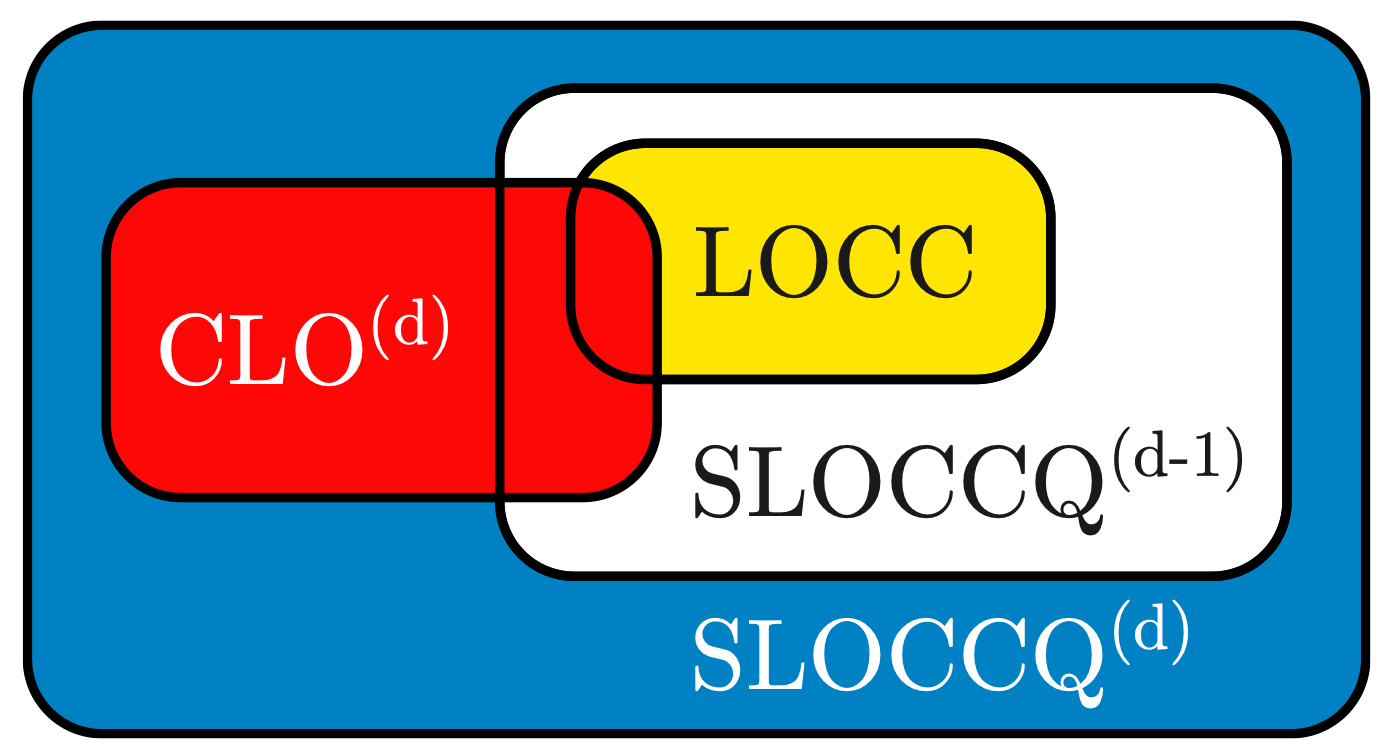
A key result in entanglement theory is that the addition of a catalyst dramatically enlarges the set of possible state transformations via local operations and classical communication (LOCC). However, it remains unclear what is the interplay between classical communication and quantum catalysis. Here our aim is to disentangle the effect of the catalyst from that of classical communication. To do so, we explore a class of state transformations termed catalytic local operations (CLO) and compare it to LOCC and to stochastic LOCC augmented by bounded quantum communication. We show that these classes are incomparable and capture different facets of quantum state transformations.
Catalytic Activation of Bell Nonlocality
Jessica Bavaresco, Nicolas Brunner, Antoine Girardin, Patryk Lipka-Bartosik, Pavel Sekatski
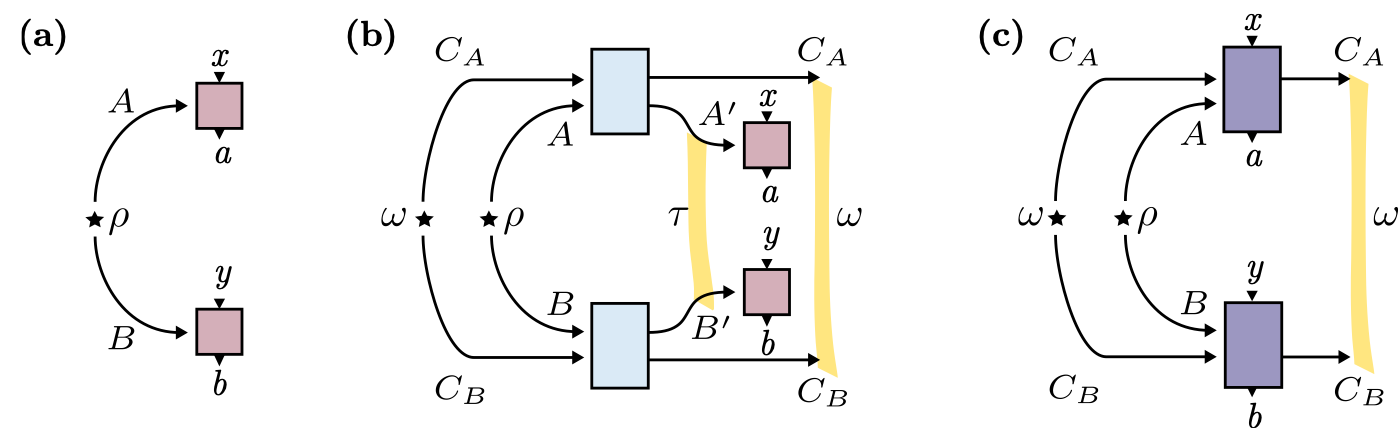
The correlations of certain entangled states can be perfectly simulated classically via a local model. Hence such states are termed Bell local, as they cannot lead to Bell inequality violation. Here, we show that Bell nonlocality can nevertheless be activated for certain Bell-local states via a catalytic process. Specifically, we present a protocol where a Bell-local state, combined with a catalyst, is transformed into a Bell-nonlocal state while the catalyst is returned exactly in its initial state. Importantly, this transformation is deterministic and based only on local operations. Moreover, this procedure is possible even when the state of the catalyst is itself Bell local, demonstrating a new form of superactivation of Bell nonlocality, as well as an interesting form of quantum catalysis. On the technical level, our main tool is a formal connection between catalytic activation and many-copy activation.